

2026 Top Poly Water Tanks Best Choice for Global Buyers?
In 2026, poly water tanks are becoming a practical choice for farms, homes, construction sites, and emergency storage. Their lightweight structure simplifies transport, while rotationally molded polyethylene resists corrosion, sunlight, and many common chemicals. A 5,000-litre tank can arrive on a small truck, then sit beside a rainwater pump or greenhouse. That physical convenience matters.
The United Nations World Water Development Report 2024 states that agriculture accounts for roughly 70% of global freshwater withdrawals. This figure strengthens the case for dependable on-site storage. Grand View Research’s water storage systems analysis also identifies infrastructure expansion, rainwater harvesting, and water security as major market drivers. These reports do not prove that every tank is suitable. They show why buyers are asking better questions about capacity, material quality, fittings, UV protection, installation, and service life.
Water expert Peter Gleick once warned, “The world’s water crisis is not about having too little water to satisfy our needs. It is a crisis of managing water badly.” His point applies directly to poly water tanks. A cheap tank may fail through poor placement, weak accessories, or unclear specifications. That is easy to overlook. The best global choice is therefore not simply the largest model. It is the correctly engineered tank, supported by transparent testing and regional after-sales service. Buyers should still challenge supplier claims. Not every “food-grade” label means the same thing, and not every 2026 product deserves confidence.
What Are Poly Water Tanks and How Do They Work?
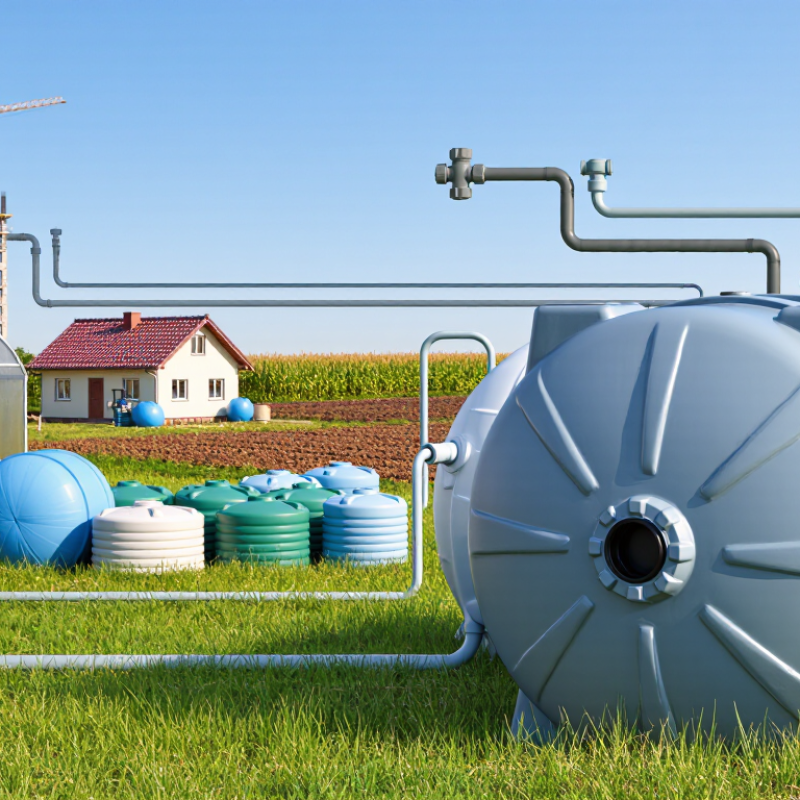
Poly water tanks are containers made from polyethylene, usually through rotational molding. The process forms a seamless, one-piece shell with fewer leak points. Their walls resist corrosion, mild impacts, and many outdoor weather conditions. UV stabilizers help slow sunlight damage, but they cannot prevent aging forever.
These tanks usually work as atmospheric storage systems. Water enters through an inlet controlled by a float valve. It leaves through a lower outlet, using gravity or a pump. The tank itself does not create water pressure. A pump, pressure vessel, or elevated installation must provide that force. According to the WHO and UNICEF Joint Monitoring Programme 2023 report, 2.2 billion people lacked safely managed drinking water in 2022. Reliable storage can support household, agricultural, and emergency water planning, especially where supply is irregular.
Correct installation matters. A full tank needs a firm, level base, because uneven support can distort its bottom. Installers should check fittings, overflow routes, ventilation, and cleaning access before filling. The UN World Water Development Report 2024 also emphasizes resilient water management under climate pressure. A larger tank is not always better. Oversizing may leave water stagnant, while undersizing causes frequent shortages. That trade-off deserves careful review. No poly tank is maintenance-free. Sun exposure, sediment, temperature changes, and poor plumbing can shorten its useful life. Regular inspection remains essential.
| Evaluation Dimension | Typical Data or Specification | What It Means for Global Buyers |
|---|---|---|
| Tank Material | Rotationally molded polyethylene, commonly linear low-density polyethylene or high-density polyethylene | Polyethylene is lightweight, corrosion-resistant, and suitable for many water-storage applications. The exact resin grade should be confirmed in the technical data sheet. |
| Manufacturing Method | One-piece rotational molding with no welded seams in the main tank body | A seamless body can reduce potential leak points and supports consistent wall formation. Fittings, lids, and outlets still require proper installation and inspection. |
| Common Capacity Range | Approximately 500 to 30,000 liters for common residential, agricultural, and light-commercial models | Smaller tanks are suitable for homes and backup storage, while larger tanks are used for rainwater harvesting, irrigation, livestock, and process-water storage. Actual available sizes vary by market. |
| Water Storage Capacity | 1,000 liters = 1 cubic meter; 1,000 liters of fresh water weighs approximately 1,000 kilograms | The supporting surface must be engineered for the full filled weight, including the tank, fittings, and any accessories. |
| Operating Principle | Stores water at atmospheric pressure and normally supplies it by gravity or through an external pump | Most poly water tanks are not pressure vessels. A pump, pressure tank, or elevated installation may be required when the application needs stable water pressure. |
| Typical Tank Shape | Vertical, slimline, horizontal, underground, and low-profile configurations | Vertical tanks generally use less floor area, slimline tanks suit narrow spaces, and underground models require site-specific excavation, drainage, and installation procedures. |
| Temperature Consideration | Common service guidance is about 0°C to 60°C for water storage, subject to the manufacturer’s specification | Freezing water can expand and damage fittings or connected pipework. Hot-water use requires a tank specifically designed and rated for elevated temperatures. |
| UV Protection | Outdoor tanks commonly use UV-stabilized polyethylene or a UV-resistant outer layer | UV stabilization helps reduce weathering from sunlight, but it does not eliminate aging. Shade, correct installation, and periodic inspection can extend service performance. |
| Potable-Water Suitability | Must be confirmed through the tank’s food-contact or drinking-water compliance documentation | A polyethylene tank is not automatically suitable for drinking water. Buyers should verify the applicable certification, resin declaration, fittings, and local regulatory requirements. |
| Water Compatibility | Generally suitable for rainwater, municipal water, and many non-aggressive aqueous liquids | Compatibility depends on the liquid, concentration, temperature, and exposure time. Chemicals, fuels, solvents, and aggressive liquids require a specific compatibility review. |
| Typical Empty Weight | Often substantially lighter than a similar-capacity concrete or steel tank; exact weight depends on capacity, wall thickness, and accessories | Lower empty weight can reduce transport and handling requirements, but a suitable lifting method and safe handling procedure are still necessary. |
| Installation Base | Firm, level, continuous support covering the complete tank footprint | Uneven ground, point loading, loose fill, or inadequate support can deform the tank and stress the outlets. The base should be prepared before delivery. |
| Inlet and Outlet Options | Common connections include threaded, flanged, bulkhead, or molded fittings in metric or imperial sizes | Connection size and thread standard should match the local pipe system. Flexible connectors can help reduce stress caused by movement or settlement. |
| Overflow and Venting | Overflow capacity should be at least adequate for the maximum inflow; the tank must remain properly vented | Correct overflow routing prevents flooding around the foundation. Venting helps avoid vacuum or pressure conditions during filling and discharge. |
| Maintenance Requirements | Periodic inspection, sediment removal, lid and screen checks, fitting inspection, and cleaning when required | Maintenance frequency depends on water quality and use. Rainwater systems may require more frequent checks of filters, gutters, screens, and sediment levels. |
| Expected Service Life | Many outdoor polyethylene tanks are designed for long-term use; approximately 15 to 30 years is a common planning range, depending on conditions | Actual service life depends on UV exposure, temperature, installation quality, chemical compatibility, handling, and maintenance. A guaranteed life should be taken only from the product warranty. |
| Transport Considerations | Empty tanks are comparatively lightweight but may require oversized-load planning for large diameters | International buyers should check container or truck loading dimensions, packaging, unloading equipment, port handling, and local road restrictions before ordering. |
| Common Applications | Rainwater harvesting, domestic backup supply, irrigation, livestock water, construction sites, and non-potable process water | The application determines the required capacity, fittings, certification, access opening, filtration, pump arrangement, and installation method. |
| Key Purchase Checks | Capacity, dimensions, empty weight, wall construction, UV protection, water certification, fitting sizes, warranty, and installation instructions | Comparing these items on a like-for-like basis helps buyers avoid selecting a tank that does not fit the site, local regulations, water quality, or intended operating conditions. |
| Important Note | Specifications shown are typical industry ranges and guidance rather than a specification for one particular product. Buyers should confirm the final technical data, compliance documents, drawings, installation requirements, and warranty conditions before purchase. | |
Related Posts
-
Top 10 Water Tanks for Every Homeowners Needs?
-
Top Big Water Tanks for Global Buyers in 2026?
-

How to Choose the Best Water Storage Tanks for Your Needs in 2025
-
2026 How to Choose the Best Water Tanks in NZ for Your Needs?
-
2026 Top Water Storage Tanks for Home and Garden Use?
-
2025 Guide: How to Choose the Right Water Storage Tanks for Your Needs